Your first running event: make a local 5K your goal
Sometimes it helps to have something on the calendar that makes you want to keep running. A local 5K can be that goal: a day when your usual training leads to a starting line, other runners, your personal running number on your shirt and a route you have chosen to take on.
Your first running race does not have to be a huge event or involve a trip away. A community run through familiar streets or a nearby park can give you plenty to look forward to. If you have a friend who runs, make it a shared goal. You can prepare together, head to the start together and have someone to talk it all over with afterwards. Just try to get some nice reminder at the finish like a medal or ribbon, it will be a new motivation tool for the next months.
Find a local event you actually want to do
Start with what appeals to you. Perhaps you like the idea of running through your own neighborhood with people you know cheering along the route. Or you would prefer a smaller event that is easy to get to but away from your everyday life.
Look at the distances available and read what the organizer says about the course. A 5K is five kilometers, about 3.1 miles. It can be a clear first goal when it fits your current running and the distance you are working toward. Check the time limit and any rules about walking too, rather than assuming every event works the same way.
Choose a date that leaves you enough room to prepare. Having an event in mind can be motivating, but it should not push you to rush through your training. A later race can be just as worthwhile if it suits your progress and schedule better.
Give your running buddy a reason to join you

A shared event gives you more than a race date. You can choose it together, compare the practical details and arrange a few runs as it gets closer. It also gives your conversations a new focus: how training is going, what you are looking forward to and who has worked out where the start is.
You do not need to run at exactly the same pace. Talk about what taking part together means before the event. Will you stay together for the whole route, or travel together and each run at your own pace? Either approach can work. Agreeing in advance avoids one person feeling they have to keep up with the other. It’s often best to run your own pace and meet up at the finish line.
If you do not have a running buddy, no problem, you can absolutely make the event your goal. Perhaps someone would enjoy coming along to cheer, or meeting you after the finish.
Let the event give ordinary runs a purpose
On an evening when getting changed feels like a chore, it may help to picture the local event you picked. You have something specific ahead of you, rather than a vague intention to run more.
If you are still building toward five kilometers, Run Trainer’s built-in 0–5K plan can give your preparation some structure. You follow the lessons in the app, with spoken instructions guiding the different parts of each workout.
There is no need to turn every session into a rehearsal for race day. Keep room to repeat a lesson or adjust your plans. The event is something you want to enjoy working toward, rather than another appointment you feel pressured to be ready for.
Sort out the practical details before the day
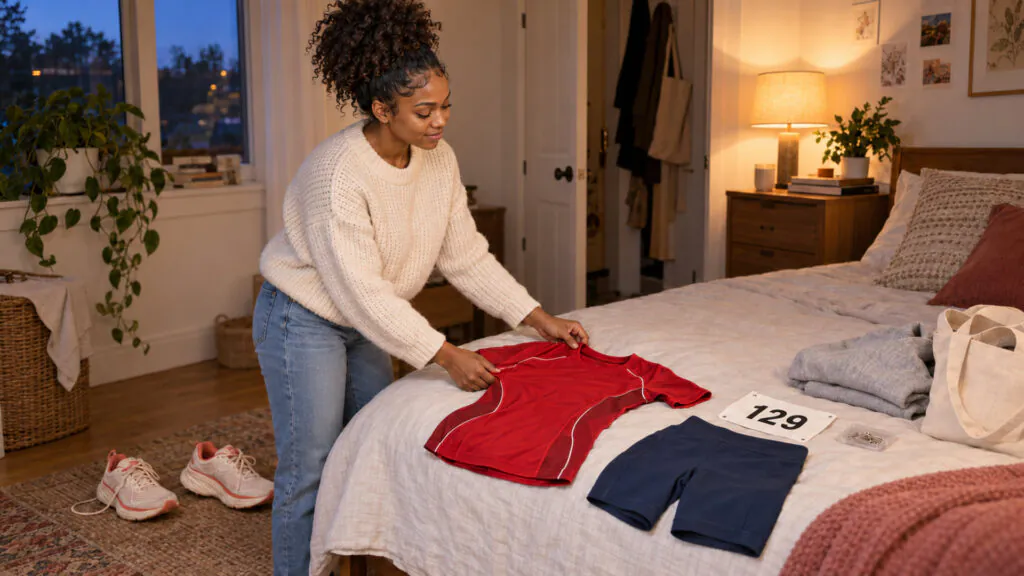
When your event gets closer, read the organizer’s participant information. Knowing a few basics makes the day less mysterious and leaves you fewer things to work out while other runners are gathering around you.
Check:
The starting location and time for your distance.
Whether your race bib is mailed to you or collected in person.
How to reach the venue and whether roads will be closed.
Whether bag storage or changing facilities are available.
Any rules about headphones or earbuds.
Set out familiar running clothes and shoes, and consider dry clothing for afterwards. If you are going with a friend, choose a specific meeting point before the start and after the finish. “Somewhere near the crowd” is less useful than a spot you can both find.
You do not have to know everything at your first start
Leave yourself time to arrive, find your way around and use the restroom if needed. If something is unclear, ask a volunteer rather than assuming everyone else already knows exactly what to do.
Where an event uses start corrals or pace groups, follow the organizer’s instructions. The excitement around you does not mean you need to adopt another runner’s pace. The people next to you have their own experience and reasons for being there.
Give yourself room to notice the occasion as well. A route can feel quite different with fellow runners and supporters along it, even if you know the streets. Afterwards, you and your buddy can compare the moments you enjoyed. Your finishing time may be interesting, but it will not describe everything about taking part for the first time.
You do not need to know where this first goal will lead

One of Run Trainer’s founders started with a simple Couch to 5K in the app. He later went on to take part in the New York City Marathon twice.
That is a personal story, rather than a prediction of what anyone else should aim for. It shows why you do not have to map out your entire running future before beginning. A first local event may make you curious about another challenge, or that nearby 5K may become the distance and occasion you enjoy returning to.
Have a look at events in your area and find one you would like to be part of. Ask your running buddy, check the date and distance, and give yourself something concrete to look forward to. Your first starting line can be close to home.
Want to read more?